
In my previous blog “The Dangers of Sora AI”, I discussed the ethical dangers when it comes to generative AI, especially the new Sora 2 AI model, created by OpenAI. Now, I will address the detrimental impact that generative artificial intelligence has on the environment.
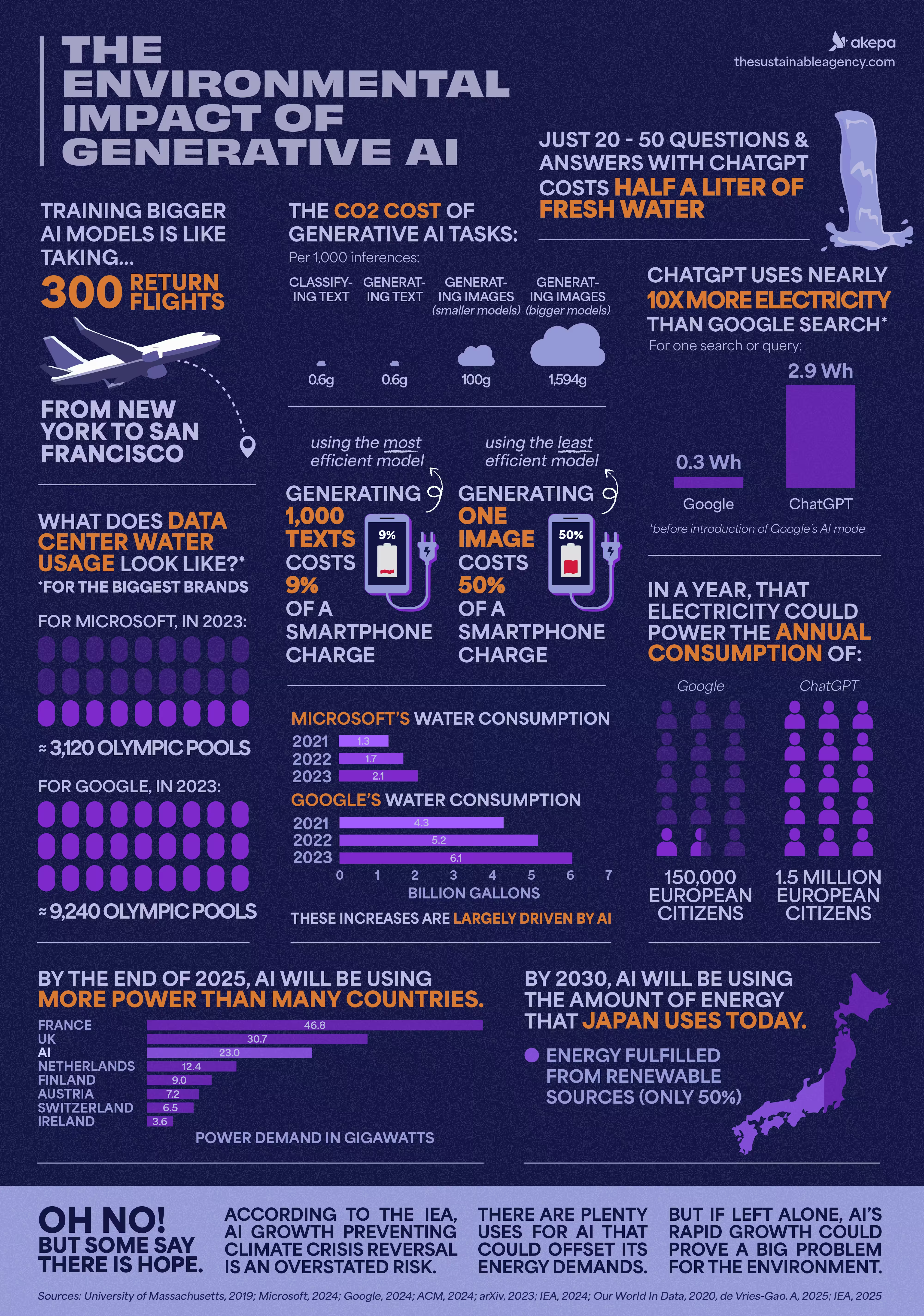
Before I talk about the effect of AI video generators such as Sora 2, I will expand on the environmental effect of generative AI in general. Recently, there has been a boom in the creation of AI models around the world, and it is causing a high demand in energy, because training the AI models uses a lot of power. A great amount of water is also needed to run these models because it is used to cool down the hardware that is used to train, deploy, and fine-tune them. Some researchers have found that training GPT-3 would have consumed around 700,000 liters of freshwater at Microsoft’s American facilities.The biggest demand is coming from data centers: temperature-controlled buildings that store servers, data storage drives, and network equipment. According to Noman Bashir, a Computing and Climate Impact Fellow at MIT, “a generative AI cluster might consume seven or eight times more energy than a typical computing workload.” The power requirements of data centers in North America increased from 2,688 megawatts to 5,341 megawatts from the end of 2022 to the end of 2023, according to scientists. Around the world, the electricity consumption of data centers rose to 460 terrawatt hours in 2022, which made data centers eleventh largest electricity consumer in the world. A terrawatt hour is the amount of power generated by a terrawatt generator over one hour. To put the sheer amount of energy being used into perspective, one terrawatt is equal to one trillion watts, and the amount of watts consumed by a standard TV over the span of an hour is typically from 50 to 200 watts. Additionally, 1,287 megawatt hours (one megawatt equals one million watts) is enough electricity to power 120 average homes in the U.S. for a year. Now, in 2026, data centers are estimated to consume 1,050 terrawatt hours, 590 more than in 2022. Given the fact that AI is starting to be used by more people every day for simple tasks, this number is only bound to grow. Below I have attached an image from an article on thesustainableagency.com with many more comparisons to help conceptualize how much electricity is used by AI.
Sora 2 is able to generate a hyper-realistic video with just a short prompt. Images, and especially videos, generated by artificial intelligence consume significantly more electricity than a simple question answered or a paragraph of text written by ChatGPT. The International Energy Agency has stated that last year, data centers used up to 1.5% of global electricity consumption. But, it predicts that by 2030, data centers will more than double their use, mostly due to the rise of generative AI. According to an article written by Robert Diab, “generating an image uses the electricity of a microwave running for five seconds, while making a five-second video clip takes up as much as a microwave running for over an hour.” This goes to show just how detrimental the popularization of video AI models like Sora 2 will be to our electricity usage, which has already dramatically increased just from the rise of text-based AI.
Sources:
https://thesustainableagency.com/blog/environmental-impact-of-generative-ai/
https://news.mit.edu/2025/explained-generative-ai-environmental-impact-0117
https://www.carboncollective.co/sustainable-investing/terawatt-hour-twh

